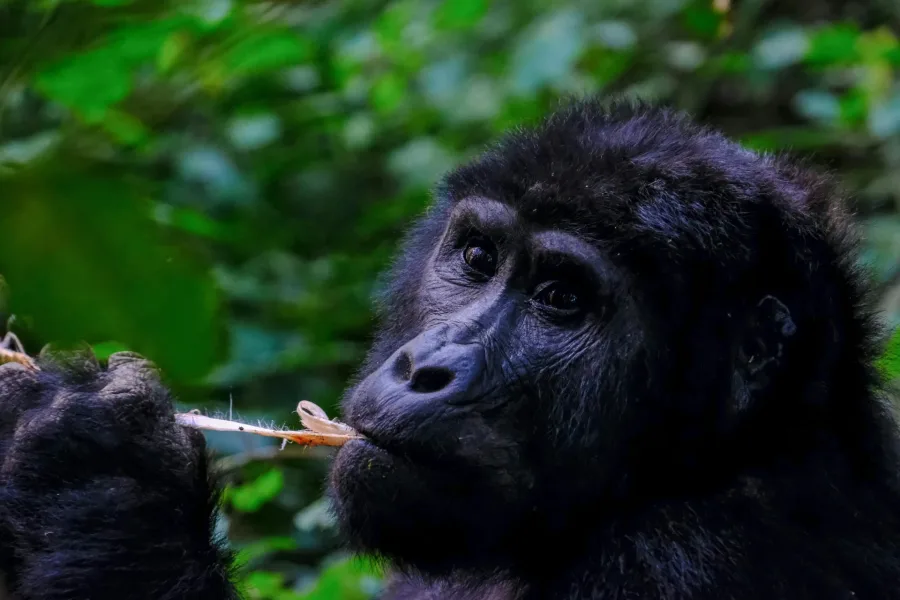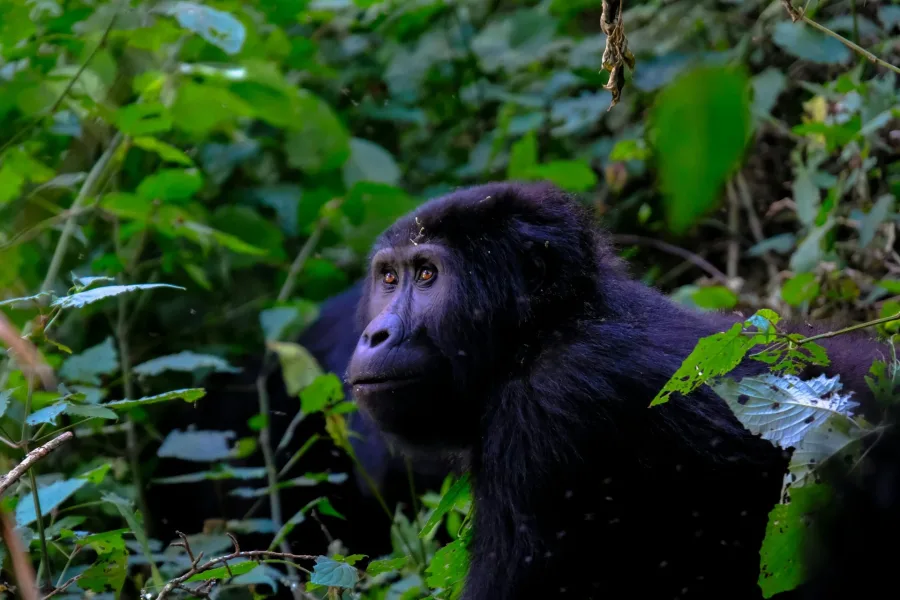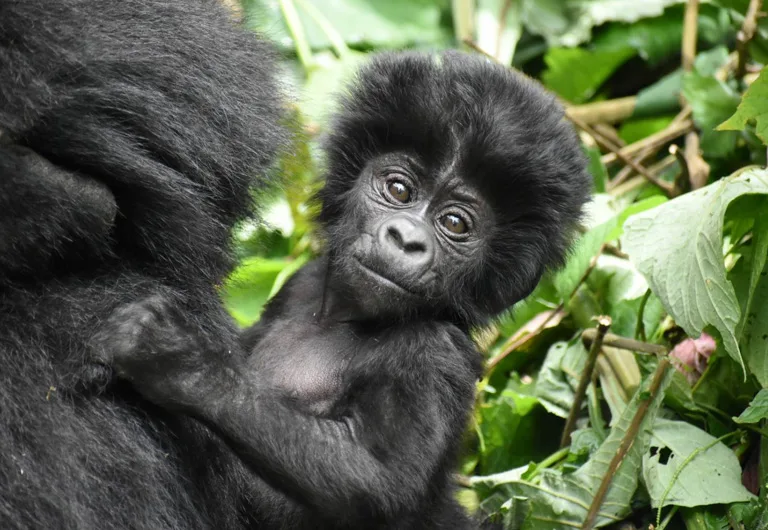
Deep in western Uganda, Kibale Forest National Park covers about 766 km² of tropical rainforest, swamp, and grassland just 26 km southeast of Fort Portal. Often called the primate capital of Africa, it holds East Africa’s greatest primate diversity and one of the continent’s densest chimpanzee populations.
Thirteen primate species share the forest, including red colobus, black-and-white colobus, L’Hoest’s monkeys, olive baboons, and grey-cheeked mangabeys. Forest elephants, buffalo, and leopard move through quieter sectors, and more than 350 bird species make Kibale a serious birding destination.
What to experience
Chimpanzee trekking
Guided treks from Kanyanchu follow habituated chimpanzee communities through the forest. Groups are limited to eight guests. Once located, you spend time watching feeding, grooming, play, and travel through the canopy. Treks typically last two to six hours. Permits are issued by the Uganda Wildlife Authority and should be booked ahead.
Chimpanzee Habituation Experience
The Chimpanzee Habituation Experience (CHEX) is a full day with researchers and a semi-habituated group, for travellers who want more than a brief encounter and a deeper look at chimp social life.
Nature walks and Bigodi
- Kanyanchu Nature Walk: the classic forest trail for primates, birds, and butterflies
- Sebitoli Trail: a northern entry with strong wildlife sightings
- Bigodi Wetland Sanctuary: a community-run wetland beside the park, excellent for monkeys, sitatunga, and more than 200 bird species
Birdwatching
Specialties include Green-breasted Pitta, African Pitta, Great Blue Turaco, Black Bee-eater, and African Grey Parrot. Forest trails and Bigodi are both strong for observation and photography.
Crater lakes near Fort Portal
Outside the park, volcanic crater lakes frame quieter evenings after the forest: Lake Saaka, Lake Nyamirima, Lake Nkuruba, and Lake Kifuruka for canoeing, birding, and viewpoint walks.
Trekking guidelines
Keep at least seven metres from chimpanzees, avoid flash photography, do not eat near the animals, and follow ranger instructions at all times. Trails can be muddy and steep, so good hiking shoes are essential.
Best time to visit
Dry seasons (June to September and December to February) offer easier forest access. Wet months bring greener canopy and strong birding, with slipperier trails.
Chimpanzee habituation in Kibale (CHEX)
Standard chimpanzee trekking gives you up to an hour with a habituated community. The Chimpanzee Habituation Experience is a full day with researchers and a semi-habituated group, ideal if you want deeper behaviour watching after (or instead of) a short trek.
Many private itineraries pair Kibale chimps with gorillas in Bwindi Impenetrable National Park and game drives in Queen Elizabeth National Park.
Is Kibale worth visiting without gorillas?
Yes, if primates and forest birding are the draw. Kibale is often called East Africa’s primate capital for a reason: thirteen species and one of the most reliable chimpanzee programmes on the continent. Guests short on time sometimes do Kibale alone as a focused western Uganda weekend before continuing south.
Getting there
Kibale is about five to six hours by road from Kampala via Fort Portal, through tea country and rolling hills, or a short flight to Kasese with a road transfer. It pairs naturally with Queen Elizabeth and Bwindi on a western Uganda safari. Explore the wider country in our Uganda destination guide.